

Insurance on Your License: Drivers License Insurance
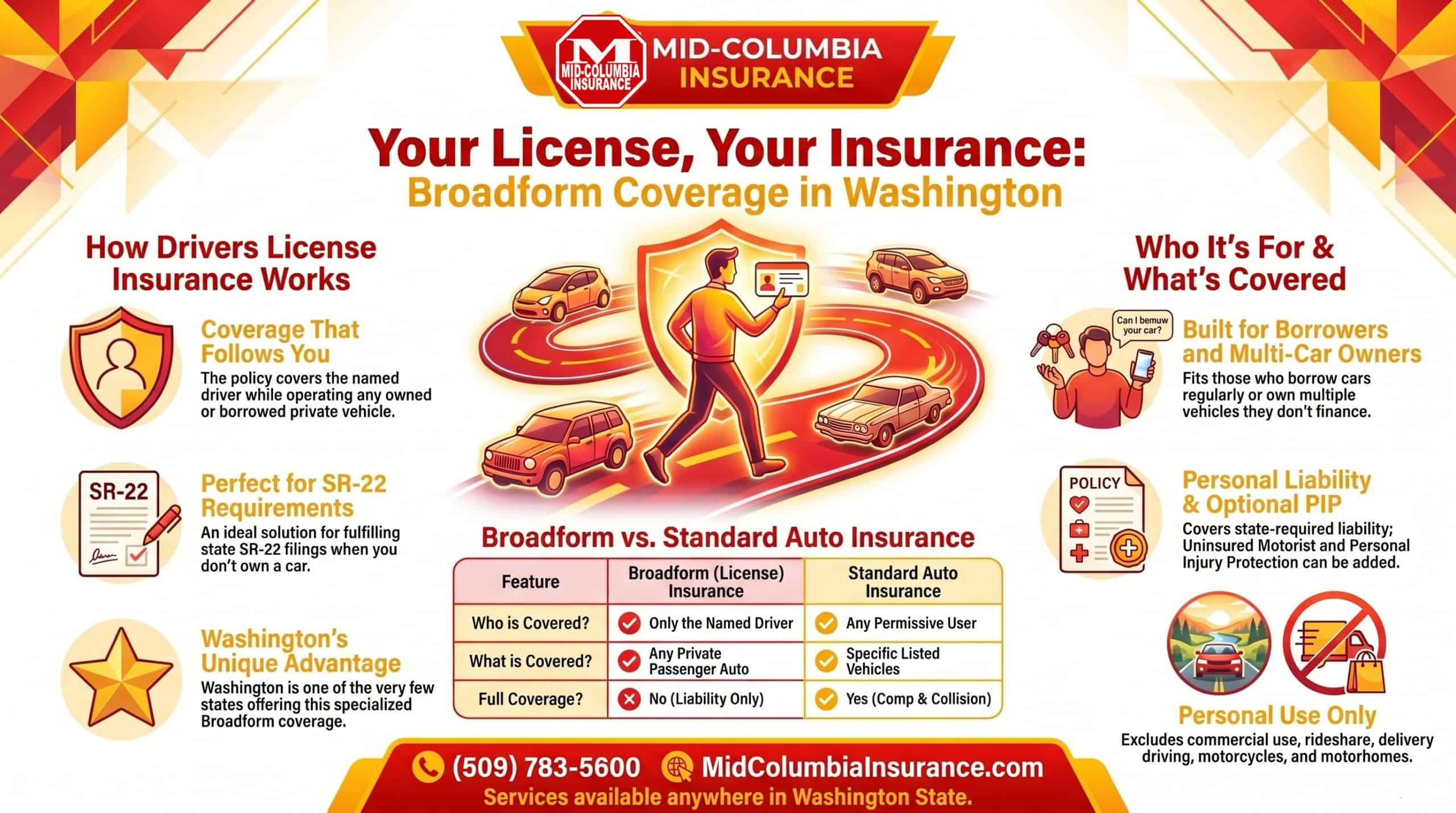
Drivers License Insurance Covers You Without Owning a Car
Drivers license insurance covers the named insured on the policy while operating any owned or borrowed private passenger automobile for personal use. The formal product name is a Broad Form Named Operator policy, but most Washington drivers just call it insurance on their license: the coverage follows the driver, not the vehicle.
Washington is one of a small number of states that authorizes carriers to write this type of driver-based liability policy. Most states don’t permit it, which means Washington drivers have access to an insurance option that simply isn’t available in most of the country.
The policy is rated on the driver’s record and profile alone. No vehicle needs to be declared at the time of purchase because the coverage isn’t attached to any specific car. One named insured, one policy and protection in whatever private passenger automobile they happen to be driving on a given day.
For drivers without a vehicle of their own, the Broad Form Named Operator policy is often the only realistic path to legal coverage in Washington. Standard auto insurance requires a listed car. This policy does not.
Here’s what drivers license insurance covers:
- Bodily injury liability paid to others when the named insured causes an accident
- Property damage liability for damage caused to someone else’s vehicle or property
- Optional Uninsured Motorist and Personal Injury Protection add-ons
- SR-22 financial responsibility filings for drivers reinstating a suspended license
| Feature | Drivers License Insurance | Standard Auto Policy |
|---|---|---|
| Coverage follows | The driver | The vehicle |
| Vehicle required to purchase | No | Yes |
| Multiple vehicles covered | Yes, any personal use vehicle | Only listed vehicles |
| Additional drivers covered | No | Yes, with endorsement |
| Physical damage available | No | Yes |
| SR-22 eligible | Yes | Yes |
Mid-Columbia Insurance has written Broad Form Named Operator policies for Washington drivers since 1995. Getting covered takes one call.
Drivers License Insurance Works for Several Types of Drivers
Drivers license insurance is the right fit for four specific groups of drivers, and most people who need it fall clearly into at least one.
The first group is drivers who don’t own a vehicle at all. Standard auto insurance won’t work here because there’s no car to list on the policy. A Broad Form Named Operator policy solves that. The named insured can drive any eligible personal-use car or pickup without calling the carrier first to add a vehicle.
The second group is drivers who own or regularly use multiple vehicles that don’t need physical damage coverage. Older paid-off cars, secondary vehicles, work trucks that don’t need collision. Instead of managing a separate policy for each, one broadform policy covers the driver in all of them.
The third group is regular borrowers. Maybe it’s a parent’s truck on weekends, a roommate’s car on days without a ride, or a sibling’s sedan for a road trip. Drivers license insurance gives those drivers their own liability coverage rather than relying on the vehicle owner’s policy to protect them.
The fourth group, often the most urgent, is the high-risk driver who needs an SR-22 filing to reinstate a suspended license. Whether the suspension came from a DUI, reckless driving, too many points or a coverage lapse, a Broad Form Named Operator policy can carry the SR-22 and satisfy the Washington Department of Licensing‘s requirement. No vehicle required.
| Driver Situation | Drivers License Insurance a Fit? |
|---|---|
| No vehicle, need coverage to drive legally | Yes |
| Multiple older vehicles, no physical damage needed | Yes |
| Regularly borrow vehicles from others | Yes |
| Need SR-22, don’t own a car | Yes |
| Own a newer vehicle with a loan or lease | No, standard auto policy needed |
| Driving for Uber, Lyft or delivery | No, commercial coverage required |
Broadform Coverage Protects You in a Borrowed Vehicle
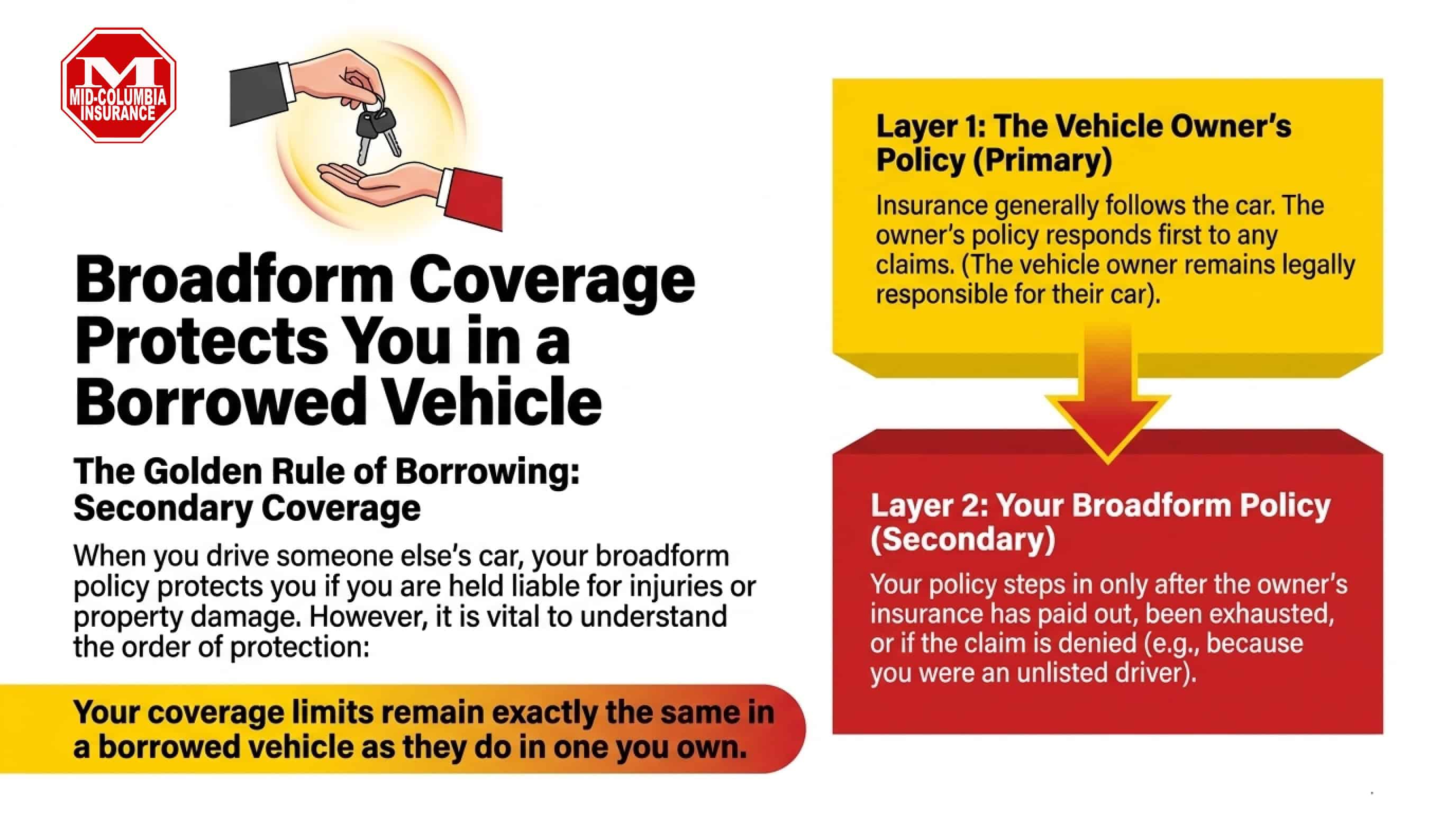
Broadform coverage protects the named insured if they’re held liable for injuries or property damage after an accident in a car they don’t own. That protection is real, but it comes with a rule every borrower should understand before relying on it.
When the named insured drives someone else’s vehicle, their broadform policy is always secondary coverage. The vehicle owner’s policy responds first. The broadform policy steps in only after the owner’s insurance has paid out, been exhausted or denied the claim.
In practice, this plays out in two different ways. If the car’s owner has adequate insurance, the named insured‘s broadform policy may never need to contribute. But if the owner’s carrier denies their claim because the driver wasn’t listed on the policy, the broadform policy becomes the primary available protection for the named insured.
One thing that doesn’t change: the vehicle owner is still legally responsible for what happens with their car. A borrower carrying their own drivers license insurance doesn’t remove the owner’s liability. If the borrowing arrangement is regular, the owner should consider adding the driver to their own policy as a listed operator.
The named insured‘s coverage is the same in a borrowed vehicle as it is in one they own. Same limits, same policy terms. Secondary coverage status affects who pays first, not what’s available.
Broadform Insurance Optional Coverages
Broadform insurance policies in Washington can include Uninsured Motorist (UM) and Personal Injury Protection (PIP) coverage, and we recommend carrying both.
UM coverage pays for the named insured‘s medical bills, lost wages and related losses if they’re injured by a driver with no insurance or not enough to cover the damages. Washington has a meaningful number of uninsured drivers on its roads. Uninsured Motorist coverage is one of the more practical add-ons available on any policy, including broadform.
Personal Injury Protection (PIP) is a first-party medical coverage that pays regardless of fault. It covers the named insured‘s medical expenses, a portion of lost wages and related costs after an accident. PIP also covers passengers in the vehicle at the time of the loss. It pays without waiting for fault to be determined, which matters when medical bills arrive fast.
Both UM and PIP can be declined in writing under Washington state law. Drivers with solid health insurance who understand the gap they’re accepting sometimes opt out to keep the monthly cost lower. For drivers without reliable medical coverage, declining PIP is a risk that rarely saves enough to justify it.
Physical damage coverage (the comprehensive Other Than Collision and collision protection that pays for repairs to the vehicle being driven) is not available on a broadform policy. The carrier has no way to rate an unspecified vehicle. Drivers who need physical damage protection on a specific car need a standard auto policy that lists that vehicle.
| Coverage Type | Available on Broadform | Notes |
|---|---|---|
| Bodily Injury Liability | Yes | Required at 25/50/10 minimum |
| Property Damage Liability | Yes | Required at $10,000 minimum |
| Uninsured Motorist (UM) | Yes | Can be declined in writing |
| Personal Injury Protection (PIP) | Yes | Can be declined in writing |
| Collision | No | Not available, vehicle unspecified |
| Comprehensive (OTC) | No | Not available, vehicle unspecified |
Drivers License Insurance and SR-22 Filing
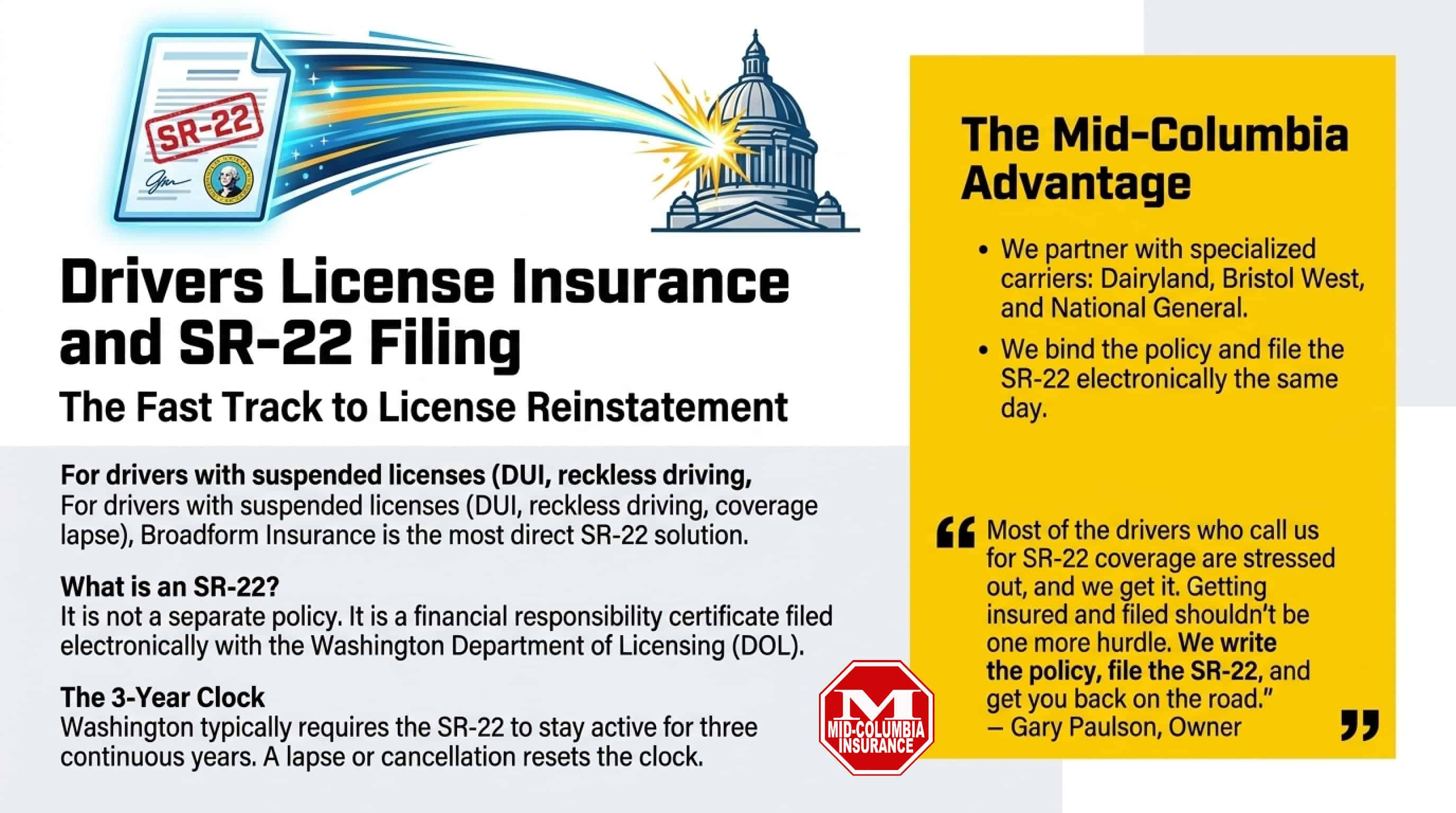
Drivers license insurance is the most direct SR-22 solution for Washington drivers who need to satisfy a state filing requirement but don’t own a vehicle. The SR-22 certificate is not a separate insurance policy. It’s a financial responsibility filing the carrier submits electronically to the Washington Department of Licensing to certify the driver carries the state’s required minimum liability coverage.
Washington typically requires the SR-22 to stay active for three continuous years. A lapse, cancellation or non-renewal during that period triggers a notification to the DOL and resets the filing clock. Keeping the policy current for the full period is the only way through.
Mid-Columbia Insurance works with carriers that write high-risk auto policies and file SR-22s for Washington drivers every day. Dairyland has specialized in the non-standard auto market for decades and is one of the most recognized carriers for broadform SR-22 coverage in Washington. Bristol West covers drivers with major violations including DUIs and suspensions. National General handles a full range of non-standard risk profiles and files SR-22s electronically.
The SR-22 can be added to a new broadform policy at the time of purchase. In most cases the filing reaches the DOL the same day the policy is bound.
Gary Paulson, owner of Mid-Columbia Insurance, puts it directly: “Most of the drivers who call us for SR-22 coverage are stressed out, and we get it. Getting insured and filed shouldn’t be one more hurdle. We write the policy, file the SR-22, and get you back on the road.”
Drivers can call (509) 783-5600 to get the policy bound and the SR-22 filed the same day.
Broadform Insurance Exclusions
Broadform insurance only covers the named insured driving personal-use private passenger automobiles, and several common situations fall outside that definition entirely.
Commercial use is not covered. Rideshare driving for Uber or Lyft, food delivery, courier work or any other arrangement where the driver is compensated for operating a vehicle is excluded. The policy provides no protection for that trip.
Vehicles outside the private passenger class are also excluded:
- Motorcycles and motor scooters
- Motorhomes and RVs
- Rental trucks and moving vehicles
- Commercial trucks and vehicles over two tons
- Any vehicle that wouldn’t qualify for a standard personal auto policy
Other drivers are not covered. If anyone other than the named insured is behind the wheel, the broadform policy doesn’t respond, regardless of permission. A parent’s broadform policy doesn’t protect a child who borrows the car. A spouse without their own broadform policy has no coverage under the other person’s policy.
Broadform policies are available to Washington state residents only. Drivers relocating out of state need to find comparable coverage in their new state, though very few states authorize this type of driver-based product.
One more practical note: if the named insured is driving but a lawsuit names both the driver and the vehicle owner, only the driver’s exposure is covered by the broadform policy.
Drivers License Insurance Liability Limits in Washington State
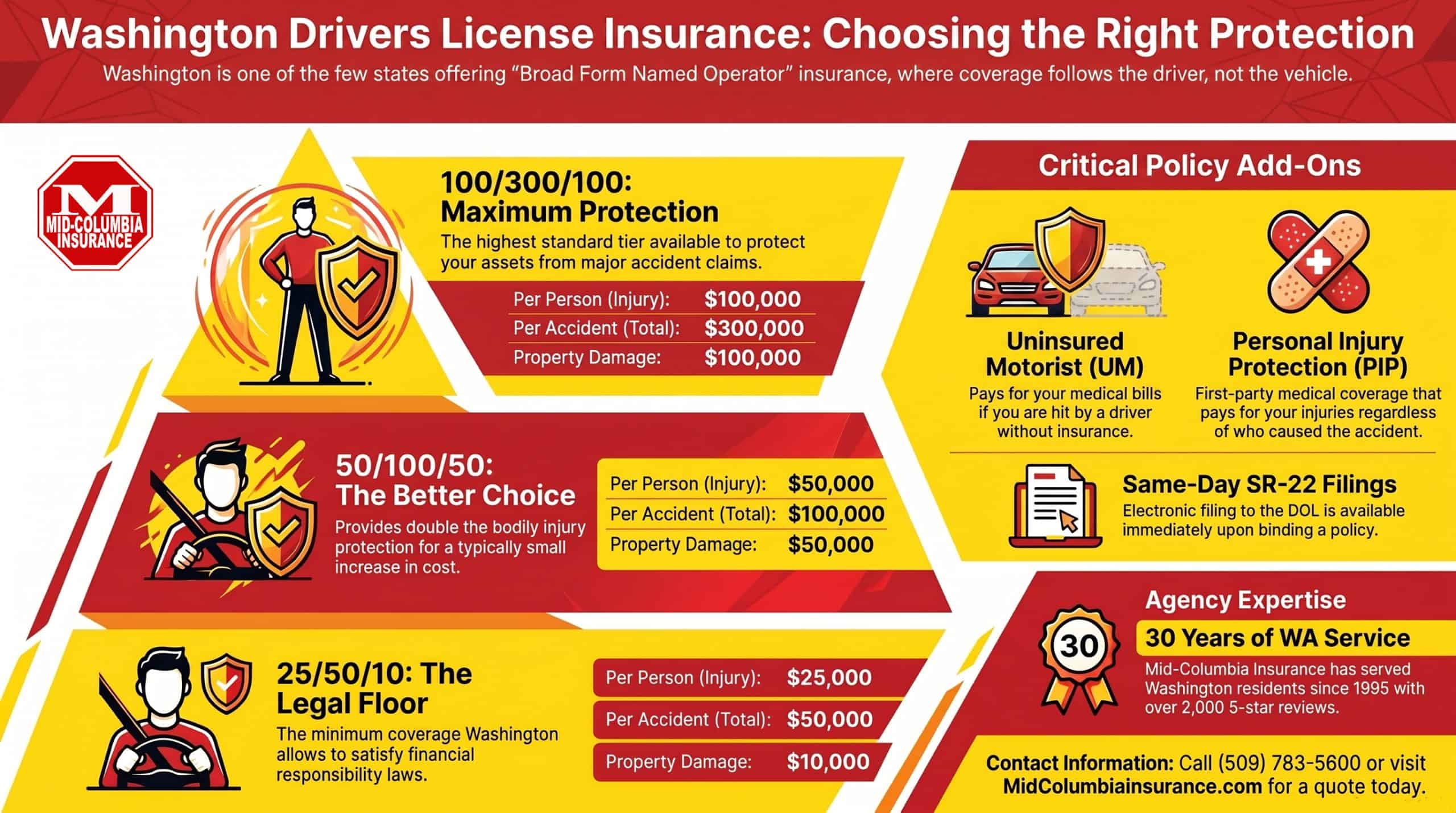
Drivers license insurance policies in Washington must meet the state’s minimum liability limits of 25/50/10 to satisfy Washington’s financial responsibility law. These minimums set the legal floor, not a recommended level of protection.
A single moderate accident can exceed $25,000 in medical bills quickly. Higher liability limits (50/100/50 or 100/300/100) are available on broadform policies and typically cost less than most drivers expect when they ask about the difference. The conversation is worth having.
| Coverage Element | Minimum Limit | What It Pays |
|---|---|---|
| Bodily injury per person | $25,000 | Maximum for one injured person in a single accident |
| Bodily injury per accident | $50,000 | Maximum for all injuries combined in one accident |
| Property damage | $10,000 | Maximum for damage to the other party’s vehicle or property |
Washington also allows drivers to satisfy the financial responsibility requirement through a surety bond of at least $60,000 filed with the DOL, or a certificate of deposit of the same amount. In practice, a broadform liability policy is significantly simpler and less expensive than either alternative. Dairyland, National General and Bristol West are in our office and can bind coverage today. The bond and deposit routes are options that exist mostly on paper.
Drivers running on state minimum 25/50/10 limits who want to revisit that decision should ask about higher limits when calling for a quote.
Drivers License Insurance vs. Named Non-Owner Policy
Drivers license insurance and a Named Non-Owner policy are both driver-based products in Washington, but the gap between them matters for any driver who owns a vehicle or borrows one regularly.
The Named Non-Owner policy covers the driver only in vehicles they don’t own, don’t regularly use and that aren’t kept at their residence. It’s designed for a narrow situation: a driver with no regular vehicle access who drives only occasionally and never borrows the same car twice. The moment the insured owns a car, any car, the Named Non-Owner policy no longer covers them in that vehicle.
Drivers license insurance removes those restrictions entirely. The Broad Form Named Operator policy covers the named insured in any private passenger automobile for personal use, whether they own it, borrow it regularly or have it parked at their address. A driver who owns an older truck without collision coverage can use a broadform policy and be covered in that truck and in any car they borrow.
| Feature | Drivers License Insurance | Named Non-Owner Policy |
|---|---|---|
| Covers owned vehicles | Yes | No |
| Covers regularly borrowed vehicles | Yes | No |
| Covers vehicles at insured’s address | Yes | No |
| Covers occasional borrowed vehicles | Yes | Yes |
| SR-22 eligible | Yes | Yes |
| Physical damage available | No | No |
| Available in Washington | Yes | Yes |
| More than one driver per policy | No | No |
For most Washington drivers comparing these two products, the Broad Form Named Operator policy is the broader and more practical option. The Named Non-Owner makes sense for one specific situation: a driver with absolutely no regular vehicle access who drives rarely and never borrows the same car consistently. That’s a real situation, but it’s not the most common one. Most drivers who ask about insurance on their license are better served by broadform.
Drivers License Insurance Quotes from Mid-Columbia Insurance
Drivers license insurance quotes from Mid-Columbia Insurance are available the same day, with SR-22 filings transmitted to the Washington Department of Licensing electronically, often within hours of binding the policy.
Mid-Columbia Insurance is an independent agency, which means we represent multiple carriers and compare coverage on your behalf rather than locking you into one company’s pricing. Dairyland, Bristol West and National General all write broadform policies through our office, giving us options for standard profiles and high-risk drivers alike. If one carrier won’t write the policy, another one likely will.
We’ve been writing Broad Form Named Operator policies for Washington drivers since 1995. The state’s roads, the DOL‘s SR-22 requirements and the carriers that write this coverage aren’t a mystery to us.
Call us at (509)783-5600 or click “Get a Broadform Quote” to request a quote on insurance on you license. If you need an SR-22, say so when you call. We’ll bind the policy and submit the filing the same day.
Our goal is to get you the coverage you want at a price you can afford!
Español: Seguro en Su Licencia de Conducir – Obtenga un Seguro Para la Licencia