

Definition
Non-standard auto insurance is a market classification, not a separate type of coverage. It’s a category of car insurance for drivers considered high risk due to past driving offenses, lapses in auto insurance coverage, inconsistent payments, or other risk-related factors. The policies themselves follow the same Washington state requirements as any other auto insurance. The difference is who writes them and what they cost.
Non-standard insurance companies must follow all state laws and regulations. They offer the same types of coverage that standard ones do, but to a broader range of customers.
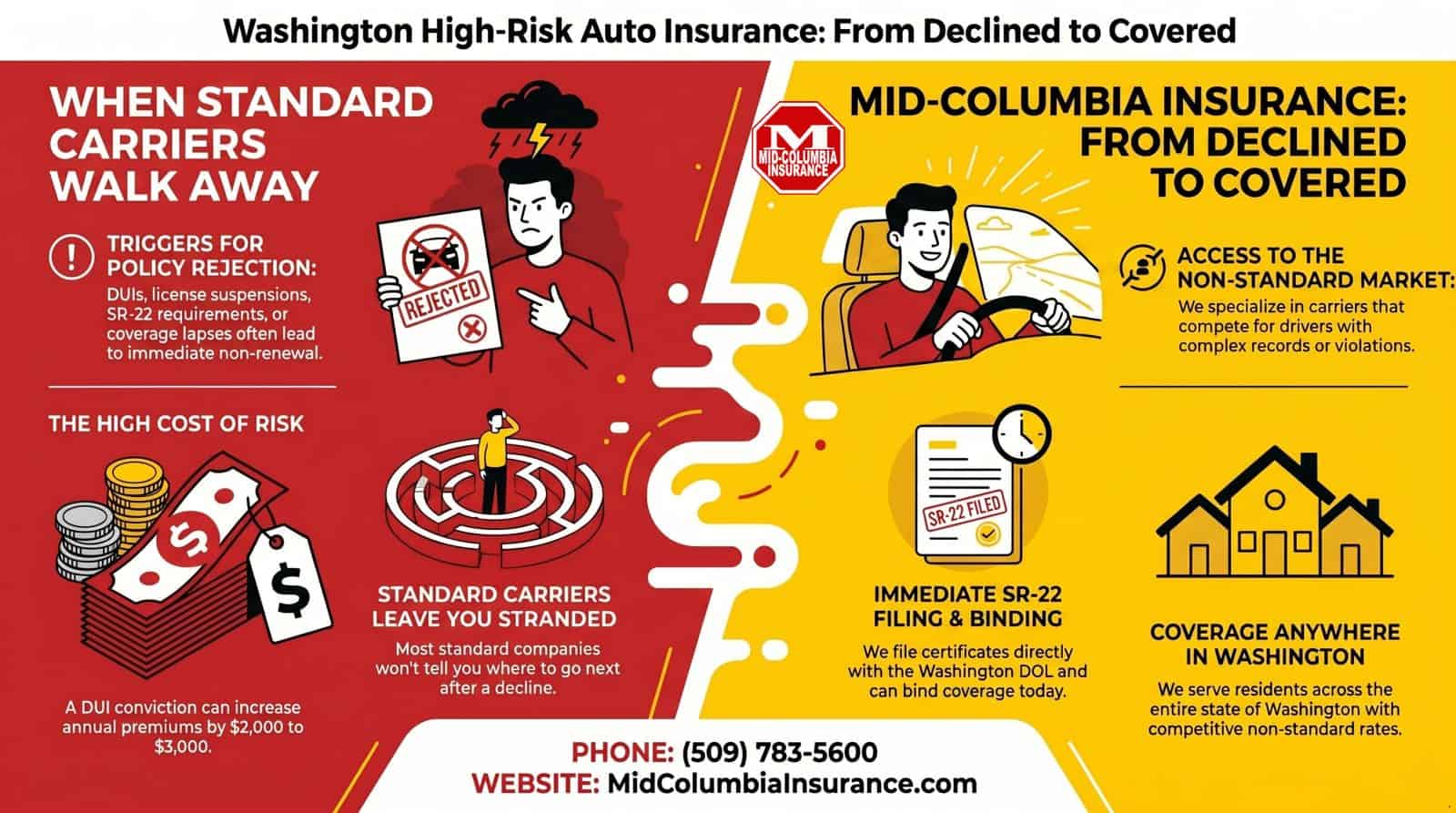
Standard Carriers Decline High-Risk Drivers Without Telling Them Where to Go
Most drivers don’t know they’ve entered the non-standard market until a standard carrier refuses to write or renew their policy.
The triggers are predictable: a DUI conviction, a license suspension, an SR-22 requirement, a coverage lapse, multiple violations within a short window, or an at-fault accident while uninsured. A DUI conviction can increase your annual premium by an average of $2,000 to $3,000, with some drivers paying even more depending on their state and circumstances. Many standard carriers won’t write the policy at all regardless of what you’re willing to pay. They don’t have the carrier appointments to file an SR-22, and their underwriting guidelines exclude drivers with the violations that trigger one.
What the standard carrier won’t tell you is where to go next.
Non-Standard Carriers Write Almost Every Risk a Driver Can Bring Them
Non-standard carriers exist specifically to write policies that standard carriers won’t touch. DUIs, suspensions, revocations, multiple violations, SR-22 requirements, coverage lapses — these are their core business, not edge cases. Non-standard insurers specialize in serving drivers that other companies won’t touch. They compete for this business, which means rates vary across carriers and shopping the market produces real savings.
If a non-standard carrier declines a risk, that driver is almost certainly uninsurable at any price. That situation is rare. Most drivers who think they have no options haven’t talked to an independent agency with actual non-standard carrier appointments.
The SR-22 side compounds the stakes. If coverage lapses at any point during the required three-year period in Washington, the carrier notifies the DOL and driving privileges are suspended again immediately. Every lapse resets the clock and adds to the record used to rate the next policy. Washington does have an assigned risk pool as a last resort, but the vast majority of drivers get placed in the voluntary non-standard market well before reaching it.
Mid-Columbia Insurance Places High-Risk Drivers with Non-Standard Carriers Directly
Mid-Columbia Insurance holds appointments with non-standard carriers and shops the market to find the most competitive rate for each driver’s specific record and situation. We file SR-22 certificates directly with the Washington DOL and can bind coverage the same day.
If a standard carrier has told you they won’t write your policy, that’s the beginning of the conversation, not the end of it. Call (509) 783-5600 or get a quote online.
Identities
- Glossary: Non-Standard Auto Insurance
- Wikipedia: Vehicle Insurance
- DBPedia: Vehicle Insurance
- ProductOntology: Vehicle Insurance
- Wikidata: Vehicle Insurance